Proof of the coloring-flow duality theorem
$\Rightarrow$ Assume that G is face k-colorable (proper coloring)
We need to show that G has a nowhere-zero k-flow $(D,f)$
Let $F(G)$ be the set of all faces of G and let $c:F(G)\to[k]$ be a face coloring.
Assign an orientation $D$ to $E(G)$: each edge $e\in E(G)$ is oriented such that the face with a smaller color index is on the right side of the arc.
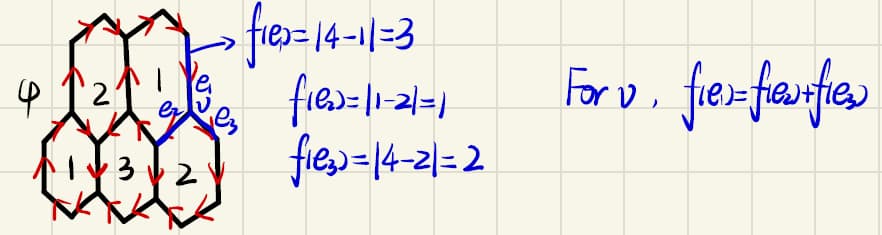
Define a function $f:E(G)\to[k-1]$ such that $f(e)$ is the absolute value of the difference of the colors of two faces incident with e.
**claim: $(D,f)$ is a nowhere-zero k-flow**Proof of claim:
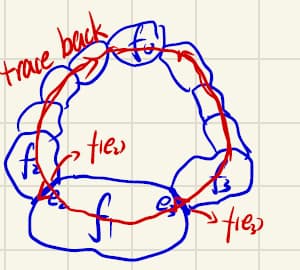
Clearly, $0Let $f_1$ be uncolored face incident with two colored faces $f_2$ and $f_3$.Let $e_i$ be the edge on the boundary of $f_1$ and $f_i$ for $i=2,3$. Without loss of generality, let $f_i$ be on the left side of the arcs $e_2$ and $e_3$.
**claim: $c(f_2)+f(e_2)\equiv c(f_3)+f(e_3)(mod\ k)$****Proof of claim:**
This completes the whole proof.
Recall: Every Eulerian graph G has a cycle decomposition: edges of G can be decomposed into edge-disjoint cycles.A cycle cover of a graph is a family of cycles which cover all edges of G.
A graph has a cycle cover $\Leftrightarrow$ it has even-subgraph cover.
Thm If a graph G has k-even-subgraph cover, then G has a nowhere-zero $2^k$-flow
Proof
For each even-subgraph $H_i$, it has a 2-flow $(D,f_i)$.
So $(D,f)$ is a nowhere-zero $2^k$-flow where $f=\sum_{e\in E(G)}2^{i-1}f_i(e)$
(8-flow theorem,Jaeger) Every bridgeless graph has nowhere-zero 8-flow
(Splitting Lemma) Let G be a connected graph without cut-edge.If G has a vertex v of degree at least four. Then there are two edges $e_1$ and $e_2$ incident with v s.t. the resulting graph after splitting $e_1$ and $e_2$ from v remains to be connected and without cut-edge.
(Cycle double cover conjecture,1970s) Every connected cubic graph without cut-edge has a family of cycles covering every edge exactly twice.A proper k-edge-coloring of a graph G is a map $c:E(G)\to[k]$ s.t. $c(e)\not=c(e’)$ if $e$ and $e’$ have a common end vertex.
Thm Every 3-edge-colorable cubic graph has a family of cycles which cover every edge exactly twice
Proof
Let $c:E(G)\to[3]$. Then $c^{-1}(1)\cup c^{-1}(2)$ is a family of cycles, $c^{-1}(1)\cup c^{-1}(3)$ is a family of cycles, $c^{-1}(2)\cup c^{-1}(3)$ is a family of cycles.
So $l{e_1}\cup l{e2}\cup l{e_3}$ is a family of cycles which cover every edge exactly twice.
(3-flow conjecture) Every 5-edge connected graph has a nowhere-zero 3-flow. A graph is a k-edge-connected if for any two vertices x ang y, the graph has k edge-disjoint paths joining x and y. (Tutte-Nashwillam Theorem) Every 2k-edge-connected graph has a k edge-disjoint spanning trees. (Lovasz,Wu,Thomassen,Zhang,2012) Every 6-edge-connected graph has a nowhere-zero 3-flow. (5-flow conjecture.1950s) Every bridgeless graph has a nowhere-zero 5-flow (Seymour,1980) Every bridgeless graph has a nowhere-zero 6-flow. For cubic graph,cycle double cover conjecture$\approx$ the strong embedding conjecture (Strong Embedding Conjecture,1980s) Every 2-connected graph can be embedded on a closed surface such that every face is bounded by a cycle.